

I Published an AI Policy (And Why Your Photographer Should Too)
There's a quiet risk in photography that happens after the shoot ends, when your images are scraped, processed, and absorbed into AI training systems. Here's why I published a policy to stop it.
Protecting Your Photographs from Becoming Training Data
There is a new, rather quiet risk in photography. It does not arrive with a camera. It does not stand next to you during a proposal. It does not interrupt a wedding ceremony.
It happens later.
When your photographs are uploaded, shared, indexed, scraped, processed, and quietly absorbed into systems that were never part of the agreement.
Artificial intelligence does not need to knock on the door. It simply learns from whatever it can access.
And that is precisely why I published an AI policy.
The Invisible Afterlife of an Image
Most people assume the journey of a photograph is simple. It is taken. It is edited. It is delivered. It is shared with friends and family.
End of story.
What they do not see is what happens at scale.
Images placed online can be:
Indexed by search engines
Scraped by automated bots
Collected into datasets
Used to train generative models
Often without the knowledge of the photographer. Certainly, without the consent of the client.
When you commission professional photography, you are not agreeing to your engagement, your wedding, or your family moments becoming anonymous examples inside a machine learning dataset.
At least, you should not be.
Why This Matters
Your photographs are not stock imagery. They are not generic content. They are personal, emotional, and often deeply intimate.
They include:
Your expressions
Your children
Your families
Your once-in-a-lifetime moments
The idea that these images could quietly contribute to training systems that generate unrelated synthetic content is not dramatic. It is simply uncomfortable.
And avoidable.
Consider this: An estimated 6 billion images were used to train LAION-5B, one of the largest AI datasets. Many were scraped from photography websites without permission or notification.
Your wedding day. Your proposal. Your family portrait.
They should never become uncredited data points in someone else's system.
What My AI Policy Actually Does
Publishing an AI policy is not about rejecting technology. It is about setting boundaries.
My policy outlines clearly:
How your images are stored
Where they are published
What protections are in place
How are they shielded from automated scraping
That your photographs are never knowingly submitted to AI training datasets
It also clarifies something important:
Your images are not content. They are commissioned work. And commissioned work carries responsibility.
Practical Protection, Not Paranoia
This does not mean hiding your gallery in a bunker.
It means taking sensible, modern precautions:
Using controlled, password-protected gallery platforms
Limiting metadata exposure
Restricting automated access where possible
Avoiding unnecessary public indexing of full-resolution files
Monitoring platform policies regularly
Working only with vendors who respect client privacy
It also means staying informed. The landscape changes quickly. Policies that were sufficient two years ago are no longer sufficient today.
Protection in this context is ongoing, not symbolic.
Why You Should Ask Your Photographer
If you are investing in professional photography—whether for your wedding, engagement, or family session—you should feel comfortable asking:
Are my images protected from AI scraping?
Do you knowingly allow training use?
Where are my files stored?
How long are they retained?
Who has access?
Do you have a published data policy?
A professional photographer should be able to answer those questions calmly and clearly.
If the answer is vague, that tells you something.
These are not intrusive questions. They are responsible ones. And any photographer who takes their work seriously will respect them.
The Balance
Photography today sits at an intersection between artistry and data. It has always required trust. That trust now extends beyond the shoot itself.
It extends into the digital ecosystem where images live long after the moment has passed.
My responsibility does not end when I deliver your gallery. It includes how that gallery exists in the world afterwards.
That is what this AI policy is about.
Not fear. Not headlines. Not trend-chasing.
Just protecting your photographs from becoming something you never intended them to be.
And in a world that is increasingly comfortable absorbing everything it can see, that feels like a line worth drawing.
Your Images. Your Story. Protected.
Every photograph I create represents a moment you trusted me to capture. That trust extends to how those images are protected, stored, and shared.
If you are planning a session in Naxos; whether a wedding, proposal, family portrait, or vacation photoshoot—and value privacy, transparency, and ethical photography practices, I would be honoured to work with you.
Why Calibrated Photography Matters More Than You Think
Modern screens are enthusiastic, colourful, and wildly inconsistent. Calibrated photography is what keeps your images from changing personality every time they move from one screen to another, preserving the mood, colour, and atmosphere exactly as they were intended.
A quiet obsession from a photographer in Naxos
There is a moment, usually sometime after sunset, when Naxos decides to show off. The sky softens, the blues lean gently toward violet, the sea calms itself, and the island looks exactly as people hope it will when they book a holiday here. It is also the moment when most photographs quietly fail.
Not because the photographer missed the shot. But because what you see on one screen is not what someone else sees on another.
This is where calibrated photography enters the room, clears its throat, and does something rather unglamorous but absolutely essential.
The great illusion of screens
Modern screens are excellent at one thing. Lying confidently.
Phones are bright. Tablets are punchy. Laptops are enthusiastic with colour. All of them are trying to be helpful, and all of them are doing it differently. A sunset that looks rich and cinematic on one device might look flat on another. Or worse, aggressively orange on a third.
Most people never notice this until it matters. Until they receive a gallery. Until they share images with family. Until they print something. And then the question appears.
Why does it not look like it did yesterday.
The honest answer is simple. Yesterday you were looking at luck. Today you are looking at consistency.
What calibration actually means
Calibration is not about making photos more colourful. It is not about pushing saturation until the sky looks like a travel poster from 1997. It is about control.
A calibrated monitor shows colours accurately. Not vividly. Not dramatically. Accurately. That means the blues are the blues that actually exist in the file. Skin tones behave like skin. Gradients remain smooth. Shadows do not collapse into black holes. Highlights do not glow like they are auditioning for a science fiction film.
In short, calibration removes surprises. And in professional photography, surprises are rarely welcome.
The uncomfortable truth about colour
Here is the part that usually causes confusion.
When a photograph is edited properly, on a calibrated system, and then prepared for real world viewing, it often looks slightly calmer. Slightly more restrained. Some people interpret this as loss.
It is not.
What you are seeing is the photograph stepping out of a wide studio environment and into the real world, where phones, browsers, and galleries live within a smaller colour space. The job is not to force the world to behave like the studio. The job is to make sure the photograph survives the journey intact.
This is why professional editing does not chase maximum colour. It chases believable colour.
Why this matters to clients
If you are viewing your photographs on a phone in New York, a laptop in London, or a tablet in Berlin, you are not seeing them through my screen. You are seeing them through yours. And yet they should still feel the same.
The sky should still feel soft. Skin should still feel natural. The atmosphere should still feel like that evening in Naxos when the light slowed down and everyone forgot to check the time.
Calibration is what makes that possible.
Without it, photography becomes guesswork. With it, photography becomes repeatable.
What we just accomplished
Recently, my entire editing workflow was recalibrated and aligned from capture to final delivery. Not to chase perfection for its own sake, but to ensure that what I see while editing is as close as technically possible to what you will see when you receive your images.
That means every decision made during editing is grounded in reality. Not in a screen that is too bright. Not in colours that only exist on one device. But in a controlled, predictable environment designed for consistency.
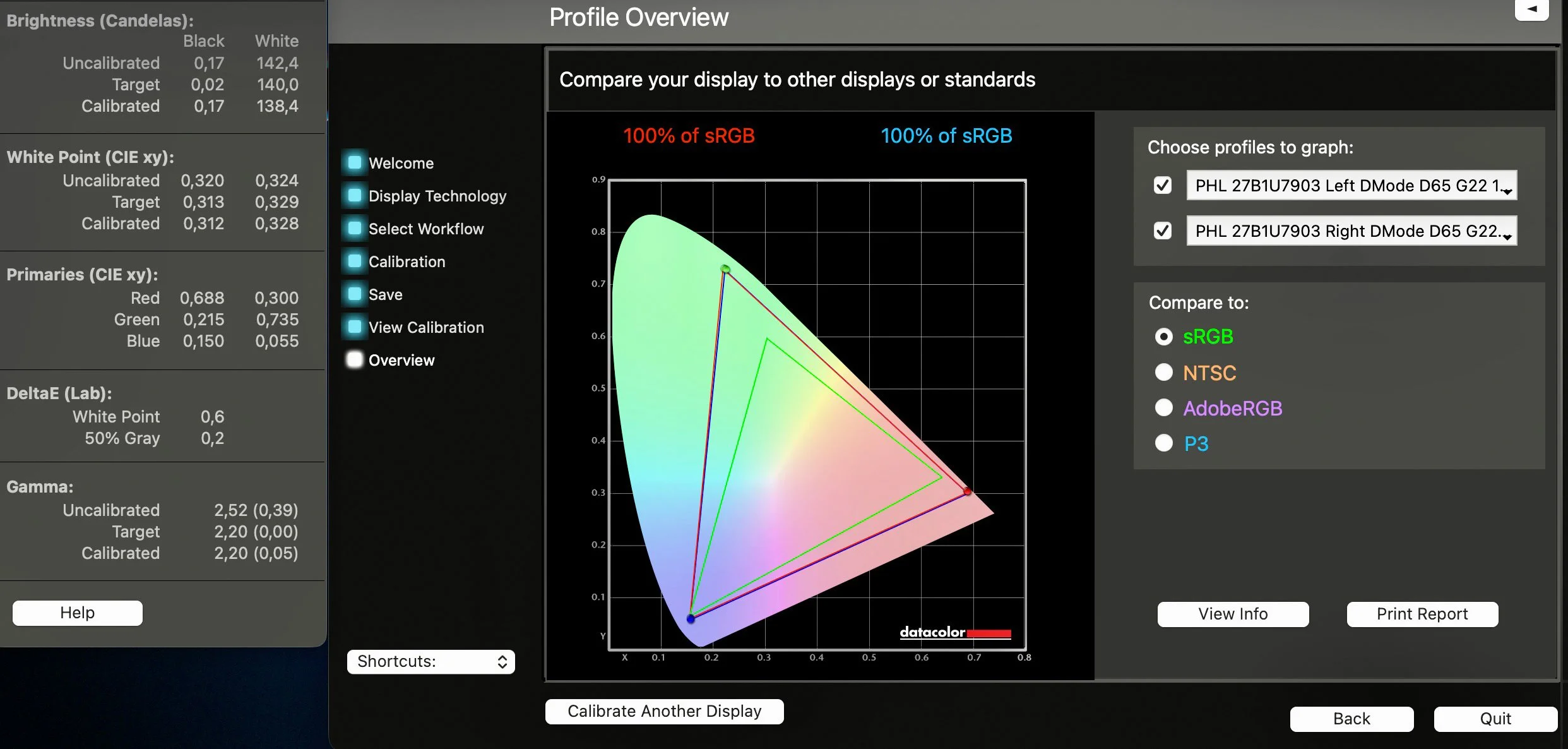
And this is where the graph you see above quietly earns its place.
It is not there to impress anyone who enjoys graphs. It simply confirms that my editing screens speak the same colour language as your phone, your laptop, and the internet at large. In practical terms, it means the blues of the Aegean remain recognisably blue rather than wandering off into something fluorescent. Skin tones stay honest instead of turning orange on one screen and pale on another. And those delicate sunset gradients that made you stop and look in the first place do not collapse into flat, awkward bands of colour once the images are shared online.
What I see while editing is, as closely as modern technology allows, what you will see when the photographs are delivered. On your screen, in your gallery, and later, if you decide to print them. The aim is not laboratory perfection. It is consistency in the real world, where images are viewed on thousands of different devices by people who simply expect them to look right.
That consistency is not accidental. It is engineered.
It is not glamorous work. It does not produce dramatic before and after screenshots. But it is the difference between photographs that travel well and photographs that fall apart the moment they leave the studio.
The quiet promise
When you book a photographer, you are not just booking someone to press a button. You are trusting them with memory, emotion, and expectation. You are trusting that what you receive will look right, not just once, but everywhere.
Calibrated photography is part of that promise. Quiet. Invisible. Absolutely critical.
You may never notice it. And that is rather the point.
Because when photography is done properly, the technology disappears, and all that remains is the feeling you remember.
And on an island like Naxos, that feeling deserves to be accurate.

The Best Proposal Spots in Naxos (According to Someone Who’s Seen Them All)
Discover the most romantic places to propose in Naxos. From iconic sunsets at the Portara to quiet beach dunes, get expert tips and photography packages to capture your perfect yes.
So you have decided to plan a proposal in Naxos. Excellent choice. The island has everything you could want for such a moment. Marble ruins, quiet beaches, and sunsets that look as if someone painted them just for you.
But here is the truth. Not every location is perfect. Some places are too busy, some are too breezy, some are better in the morning light, and some do not photograph well. As a proposal photographer in Naxos, I have quietly watched a fair number of couples get engaged, and these are the locations that always deliver.
1. The Portara (Temple of Apollo)
This is the big one. A massive marble doorway standing on its own islet and is probably the most photographed landmark on Naxos.
Why it is perfect: It is dramatic and timeless, and at sunset, it can be absolutely breathtaking.
Things to know: Privacy is not guaranteed. Everyone else on the island tends to turn up just before sunset. Arrive a little earlier, and you will have a quieter moment before the crowds gather.
Photographer’s tip: The north side offers the best light and the cleanest backdrop, which is where I will guide you.
2. Agios Nikolaos Chapel (Agia Anna)
This small, white chapel sits by the water and appears to have been built for romance.
Why it is perfect: It is quieter than the Portara and feels almost cinematic.
Things to know: The wind is a character of its own here. I will position you so your partner’s hair flows beautifully rather than straight across her face.
Photographer’s tip: I can even mark your exact spots so you do not have to think about anything except the question you are about to ask.
3. Grotta Hill Overlooking the Old Town
This is for anyone who loves a sweeping view. From the top of Grotta Hill, you can see Naxos Town, the Portara, and the sea stretching away into the distance.
Why it is perfect: You get the famous Portara in the background, but without being surrounded by people.
Things to know: There is a short climb, so wear comfortable shoes and keep the champagne for afterwards.
Photographer’s tip: Arrive about 20 minutes before sunset. The light becomes golden, the town begins to glow, and the photos are spectacular.
4. Plaka Beach Dunes
Plaka is for those who want romance with no one else around. Its dunes are quiet and stretch on endlessly.
Why it is perfect: Soft sand, warm light, and the sound of the sea make this one of the most private locations.
Photographer’s tip: Plan your proposal for the last hour before sunset and follow it with a barefoot mini shoot by the sea for relaxed, natural images.
5. Alyko Cedar Forest and Cape
Wild and a little dramatic, Alyko is perfect for those who love adventure.
Why it is perfect: The cliffs glow gold at sunset, and the sea looks impossibly blue.
Things to know: The ground is uneven, so good shoes are essential.
Photographer’s tip: The wind can be pretty intense, which can make for stunning windswept photos if that is your style.
Timing Is Everything
Photographers talk about golden hour as if it were some kind of religion, and it is easy to see why. The light softens, turns warm, and makes everything look just a little bit magical.
If privacy is your priority, early morning proposals are an excellent choice, as most of the island is still asleep, and you can have the entire location to yourselves.
Choose the Right Proposal Package
Essential Proposal
Ideal for those seeking a discreet and straightforward option.
30 minutes of coverage
40 professionally edited photos with expert colour and light correction
Private online gallery with high-resolution images
Five preview photos delivered within two hours so that you can share the news straight away
Personalised assistance to plan the timing and location
Signature Proposal
Designed for those who want the complete experience.
90 minutes, including a relaxed post proposal mini shoot
Pre-event location scouting and planning consultation
70 expertly edited photos with full Adobe Photoshop retouching
Two versions of every image, natural and artistic
Priority delivery so you can relive the moment while still on holiday
Frequently Asked Questions
Is Naxos a good place to propose?
Yes. Compared to Santorini, Naxos is calmer and more private, yet just as beautiful, making it perfect for a romantic proposal.
Should I book a proposal photographer in advance?
Definitely, summer fills up quickly, and booking early means you get the best light, the best location, and someone who will ensure every detail runs smoothly.
Do we take more photos after the proposal?
Yes. Most couples choose to spend a few minutes capturing fresh engagement portraits. Your finished gallery is delivered quickly so you can share the news with friends and family.
Plan Your Proposal Today
Wherever you choose, the most important thing is that it feels like you. My job is to handle the logistics and let you focus entirely on the yes.’.

Why Your Photos Come in Two Versions — And Why It Matters
At Naxos Photographer, every image is hand-edited and delivered in two versions: a natural edit that preserves your moment, and an artistic version with cinematic flair. Discover how our editing philosophy gives your memories more meaning.
Hello! Spyros here from Naxos Photographer.
Let’s have a quick chat about photo editing—but not the automated kind that's everywhere online these days. I'm referring to proper editing, the careful, thoughtful kind we specialise in here at Naxos Photographer.
We're not just pushing buttons randomly; we're crafting memories carefully, and we do it twice, because why not?
The Philosophy of Our Editing
Booking a photography session with us isn’t just about receiving a few nice snaps. It's about acquiring handcrafted imagery. Each photo undergoes individual editing in Adobe Photoshop. No shortcuts or batch edits here—just thoughtful adjustments including:
Skin retouching: Farewell, mosquito bites and sunblock smudges.
Colour correction: The Aegean Sea remains faithfully blue, just as you remember.
Lighting adjustments: Getting the balance just right so sunsets dazzle without overshadowing your moment.
Background refinement: Ensuring the focus remains entirely on you, without distractions.
Our aim isn’t fantasy creation—it's about capturing the authentic feeling of your time in Naxos, simply polished and enhanced.
Dual Delivery: Why Two Versions?
Now, here’s the intriguing bit: each photo we deliver comes in two distinct flavours:
1. Original Edit – Authentic & Natural
Exactly as you remember it—true colours, genuine atmosphere, polished but fundamentally honest.
2. Artistic Edit – Atmospheric & Cinematic
This version introduces a gentle artistic interpretation—perhaps a warmer glow, a soft matte finish, something cinematic. Ideal for albums, frames, or showing off on social media.
Why two?
Because tastes vary, and moods can shift. Sometimes clarity is preferred; other times, poetic license is desirable. We give you both, so you don't have to choose.
The Experience We Aim For
When you explore your photo gallery from Naxos Photographer, our hope isn't just that you skim through some images—we want you to relive moments:
The gentle breeze on the beach that caught your hair perfectly.
The spontaneous laughter shared with your family.
The tender moment following a surprise proposal.
These aren’t merely photographs; they’re chapters of your personal story. Hence, our delivery of both an honest, straightforward edit and a more stylised, emotional version. Your memories merit both accuracy and artistry.
Who Is This For?
Our dual-delivery editing method is designed specifically for people who care about depth, detail, and quality over quantity. If you:
Value professional editing and timeless photographs.
Prefer meticulous editing rather than generic filters.
Enjoy having both straightforward and artistic options.
Are considering a couples session, family photoshoot, or romantic proposal on Naxos.
Then our approach is precisely for you.
Quality Above Quantity—Every Time
Admittedly, carefully editing every photograph twice takes a bit more effort.
Yes, automation would be quicker. Yes, presets could be simpler. But we avoid these shortcuts deliberately.
Why? Because shortcuts rarely tell your story convincingly.
Every image we release has been refined with care and attention, leaving you with a carefully curated gallery of genuinely meaningful photos.
Why Our Clients Keep Returning
We regularly hear that our photography and editing feel distinctive—more human, more thoughtful, more sincere.
Clients often say things like”
"These images genuinely take me back."
"The artistic edits are simply beautiful."
"It's wonderful to have two versions of each photo."
That's what happens when you do things properly.
One Island, One Story—Yours
Naxois isn't merely a location; it's an atmosphere, a feeling, a memory whether you’re exploring the charming lanes of Naxos Town, relaxing on Agios Prokopios beach, or making memories at Portarawere committed to preserving those moments.
Twice—giving you the choice, every time.
Final Thought
In Today's hurried world, where "good enough" has sadly become acceptable, we deliberately choose to do things differently—slowly, methodically, and personally.
We sincerely hope you enjoy both.
—Spyros
Founder & Lead Photographer
Naxos Photographer
Dual Delivery. Maximum Meaning.